Summit Sales Awards · specification guide
Prepare a sales awards order for a global winners event
Separate qualification awards from ranked results, approve the reporting period and then map each recipient to the event or delivery destination. The order should make clear which numbers describe an actual result, which titles recognize membership and which pieces belong to a team.
Reviewed 2026-09-05 · AI-assisted editorial review. General buying guidance; illustrative scenarios are not customer case studies. Images are AI-generated concepts.
Choose the construction before counting the shipment
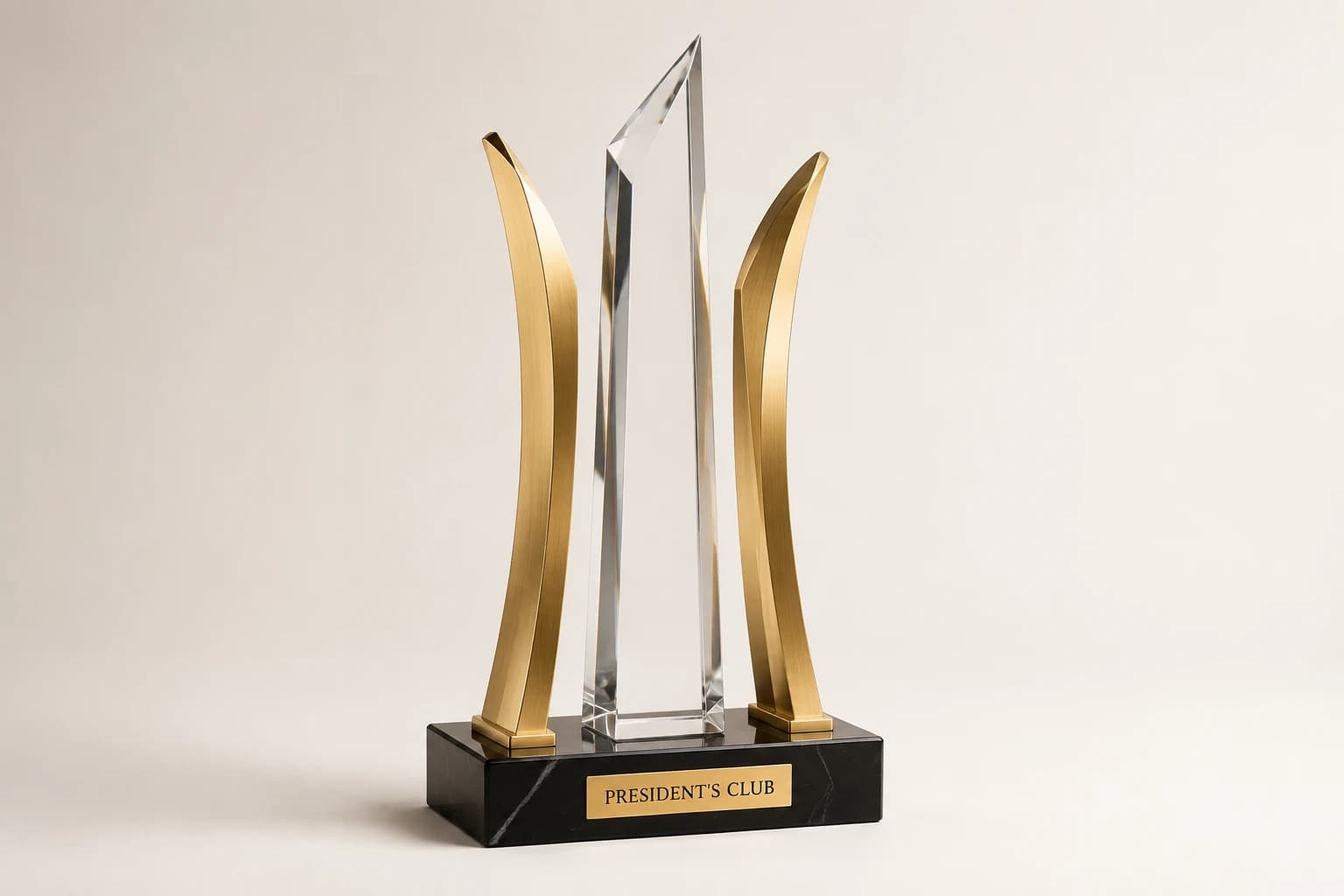
President's Club membership, highest revenue and most improved performance describe different achievements. Do not use the same inscription simply because the designs share a visual style. Ask the sales-operations owner to approve the metric name, period and displayed result. Where offices report in different currencies, a currency symbol without a code can be ambiguous. The recognition brief should contain approved presentation wording, not a spreadsheet that asks the engraver to calculate exchange rates or decide which salesperson won.

A worked quantity example
Illustrative order: eight people qualify for a club, three individuals receive ranked awards and one regional team receives a shared trophy. If two ranked winners also qualify for the club, the program can still require 12 pieces: eight membership awards, three ranked awards and one team trophy. Deduplicating names would incorrectly remove two intentional recognitions. Use a recipient reference plus award category as the row identity. Keep the event packing list in the order the host will present the awards, with separately approved wording for the shared result.
Compare relevant design starting points
The catalog offers different starting points for this brief. Compare the intended use and proposed specification below, then ask which construction and included components fit your own receiving and display plan. These are design proposals, not measured packed goods.
| Option | Intended use | Proposed material and size | Personalization |
|---|---|---|---|
| Sales Achievement Trophy | Put the climb behind the result on display. The achievement trophy uses an upward form in metal, acrylic and hardwood to frame a sales achievement. | Satin metal, acrylic and hardwood. 12 in tall | Winner; Award; Period; Organization |
| Top Closer Acrylic Award | Recognize the person who brought the deal over the line. A compact acrylic award pairs the winner's name with the exact closing achievement your team celebrates. | Clear acrylic with metal accents. 9" H | Winner; Category; Period; Team |
| Rookie of the Year Award | Celebrate a strong first chapter. The rookie award recognizes a new salesperson's achievement without making the inscription sound like a long-service award. | Acrylic or metal. 8" H | Recipient; Award; Period; Team |
| Sales Team Championship Trophy | Give a winning sales team a trophy they can share. The design brings the team name and competition title together for display in a common workspace. | Metal and acrylic. 14" H | Team; Competition; Placement; Year |
When to consider Sales Achievement Trophy
Choose one clear measure for the main inscription: a club qualification, sales rank or named milestone. If teams use different performance measures, separate those categories so the trophy never leaves viewers guessing what the winner achieved.
Example layout fields: Winner: Riley Carter; Award: President's Club; Period: 2026; Organization: Northline Sales. The names and wording are illustrative. Open this design from the collection to replace them with your approved information.
When to consider Top Closer Acrylic Award
Choose whether this is a monthly, quarterly or annual award. If several sales categories exist, make the category explicit so a top closer award is not confused with a revenue, renewal or customer-service distinction.
Example layout fields: Winner: Jamie Lee; Category: Top Closer; Period: Third Quarter 2026; Team: Enterprise Sales. The names and wording are illustrative. Open this design from the collection to replace them with your approved information.

When to consider Rookie of the Year Award
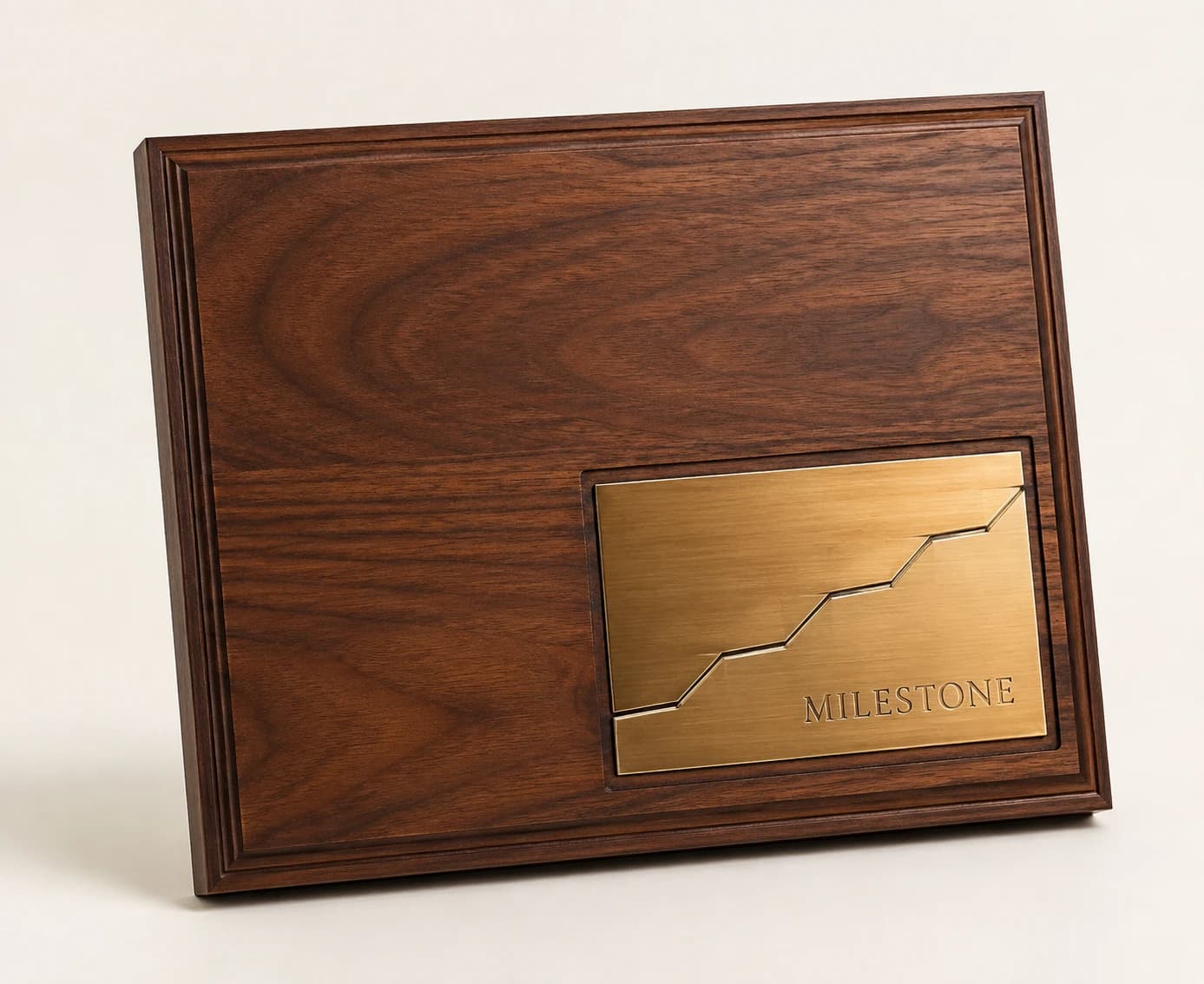
Use the exact recognition period and a title your team understands. If eligibility is based on a first full year rather than a calendar year, place the date range on the award to preserve that distinction.
Example layout fields: Recipient: Avery Chen; Award: Rookie of the Year; Period: 2026; Team: Northline Sales. The names and wording are illustrative. Open this design from the collection to replace them with your approved information.
When to consider Sales Team Championship Trophy
Separate the team's award from individual performance prizes. If the roster is long, use a team name on the front and request a secondary panel for contributors so the main inscription stays readable.
Example layout fields: Team: The Summit Team; Competition: Regional Sales Challenge; Placement: Champions; Year: 2026. The names and wording are illustrative. Open this design from the collection to replace them with your approved information.
Keep the piece count separate from the delivery plan
Use achievement category, approved reporting period, metric and currency code, ceremony packing order as the project-specific headings in the specification file. Add a stable row reference, the quantity of physical pieces and a receiving group. If two pieces share artwork but go to different destinations, keep separate delivery rows. If one person intentionally receives two different awards or signs, preserve both product rows. Repeated names alone are not an error.
The worksheet below totals the pieces you enter and reconciles them by receiving reference. It does not infer how many packages will be needed. One large assembly can require more than one package, and several small pieces may share a package when the final packing plan permits it. Ask for the packed dimensions, weights and component list after the construction is settled. Keep the receiving group names consistent; two slightly different labels are treated as two groups.
Use one controlling unit on the drawing
One inch equals exactly 25.4 millimeters. The worksheet converts entered width and height using that relationship and keeps the original values visible. A converted display is a convenience for review; it does not create a fabrication tolerance or certify physical fit.
Specify whether a measurement describes the overall assembly, the visible face, the engraving area or an opening in an existing holder. Include thickness, depth, hole spacing and support clearances separately when they matter. Do not round a metric opening into a convenient inch size and assume the fit is unchanged. Identify which drawing and measurement control when two references disagree, and have the responsible project contact resolve that disagreement before the proof is released.
Sources: NIST: SI units: length
Proof names and language without changing their meaning
Personal naming conventions vary across cultures. Keep the exact display text supplied by the person approving it, including accents, punctuation and name order. A shipping contact may use a different form of the name from the inscription; the artwork should not be overwritten by an address record.
For several languages, provide each approved version rather than asking the production file to translate itself. Review the longest lines, the intended reading order and any script-specific layout in the actual proof. A typed sample is useful for wording approval, but it does not establish which font or marking method will reproduce it clearly. Use an unambiguous written date or identify the intended numeric date convention. Keep the accepted text and proof revision together so later edits can be traced.
Sources: W3C: Personal names around the world
Reconcile the quantities and prepare a private brief
Enter groups of matching pieces below. Add a receiving reference and optional width and height, then review the total and the unresolved quote details. The examples above are illustrative; replace them with your own order information. No automatic spares, discounts, freight costs or delivery promises are added.
Method: Sum positive whole-piece quantities, group by the exact receiving reference and convert optional dimensions using 25.4 millimeters per inch. No spare pieces are inferred. Display conversions use at most four decimal places and do not establish manufacturing tolerances. Customs, freight, origin and arrival timing remain quote questions.
Build your international order brief
Add groups of pieces sharing a specification and receiving destination. Use an office, venue or country reference here; street addresses are not needed for this planning step. Quantities are pieces, and delivery groups are not parcel counts.
Compare the complete written order, in a stated currency
Ask each option to identify the product quantity and what is included: personalization, new artwork, tooling, presentation packaging, mounting parts or assembly work. Keep one-time charges separate from recurring piece charges so a future reorder can be discussed accurately. A starting price for a small component is not the price of a complete display. Compare the alternatives against the same approved brief before deciding that one total represents a saving.
Record the currency code next to each quoted amount. Do not combine a product estimate in one currency with a freight amount in another without an explicit conversion source and date. Ask the quote to state the freight service, any quoted import charges and the party responsible for charges that are not included. The worksheet records your requested arrangement, which still needs written confirmation. It calculates no selling price, exchange rate, tax rate or customs charge.
Confirm shipment details for the actual destination
Commercial invoices identify goods, quantities and values. Ask the shipping contact to confirm the accurate product descriptions, origin information and other documentation required for the particular shipment. This guide and its worksheet are planning aids, not customs declarations.
Give the quoting team the receiving country and the actual destination details through the order process. Confirm the ship-from location, the available service and who will answer delivery or import questions. Do not infer the origin of the goods from the storefront name or assume that an event gift has no reportable value. Keep production completion, carrier transit and the requested in-hand date as separate milestones in the written plan. The receiving date you enter below is a request, not a calculated arrival commitment.
Prepare the handoff and the receiving check
Identify any awards traveling onward with winners and compare the intended presentation box with the actual journey. Record the event organizer as the receiving contact when the hotel desk is only an intermediate handoff point. Keep final category names consistent between the host's running order, the packing schedule and the inscriptions. A translated category title needs its own approved wording.
Before distribution, match the delivered piece references and component counts to the approved schedule. Check the wording against the accepted proof and keep the packaging while any discrepancy is being reviewed. Identify the affected row, proof revision and photographs when requesting help. Preserve the order record for replacements or a repeat event; a later order still needs its own confirmed specification, price and schedule.

Collection planning overview
This existing narrated collection overview provides background for the design choice. Use the international worksheet and the receiving schedule in this guide for the delivery brief. The visuals are original design concepts rather than footage of completed shipments.
25-second overview
Specify sales awards with clear achievement wording
Define the achievement before designing the sales award. Confirm the reporting period, recipient and approved metric wording. Decide how shared wins are recognized, then reconcile categories with the physical quantity. Review the whole design family and its presentation order. Send the approved roster, artwork and delivery plan together for a written quote.
Prepare your brief and request a written quote.
Questions before the order is released
Does one delivery group mean one parcel?
No. A delivery group connects pieces to a receiver or location. The final construction, packed dimensions and protection determine the package plan. Ask for the actual parcel or freight details in the quote.
Does entering a country confirm delivery service?
No. The worksheet records the destination you want quoted. The order team confirms service for the actual address, shipping arrangements and timing in the written quote.
Will the worksheet add spare pieces or discounts?
No. It adds only the quantities you enter. Create an explicit spare-pieces row if you want extras, and keep personalized pieces separate from blanks. Any discount belongs in the written quote.
Which project details should accompany this brief?
Include achievement category; approved reporting period; metric and currency code; ceremony packing order. Keep the exact approved text and the physical specification linked to a stable row reference, then identify the receiving group for each piece.
Turn the schedule into a specific quote request
Choose a design, reconcile the physical pieces and include the decisions that remain open. The quote team can then review the construction, artwork, packing and delivery requirements as one defined project. Save the worksheet result with your approved source files so a later change can be applied to the correct group.
Sources and scope
The sources below support the cited technical details. The ordering workflows are editorial recommendations. Your project specification, price and schedule are established in the written quote and approved proof.
- NIST: SI units: length · checked 2026-09-05
- W3C: Personal names around the world · checked 2026-09-05
- UPS: How to create a commercial invoice · checked 2026-09-05
Which buying guide should you read next?
All buying guidesSeparate an award’s crystal-like appearance from its actual material specification, then compare faceting, inscription treatment and complete sample appearance without assuming optical or glass properties.
Keep the approved amount, currency and reporting period together. Format the inscription clearly without converting, rounding or redefining the sales result during artwork preparation.
Separate design preparation from final-result personalization, then compare the actual result-release date with a schedule built from confirmed production and delivery inputs.
Distinguish qualifying for a recognition group from receiving a ranked position, then make the award title, roster and object count reflect the company’s approved rules.